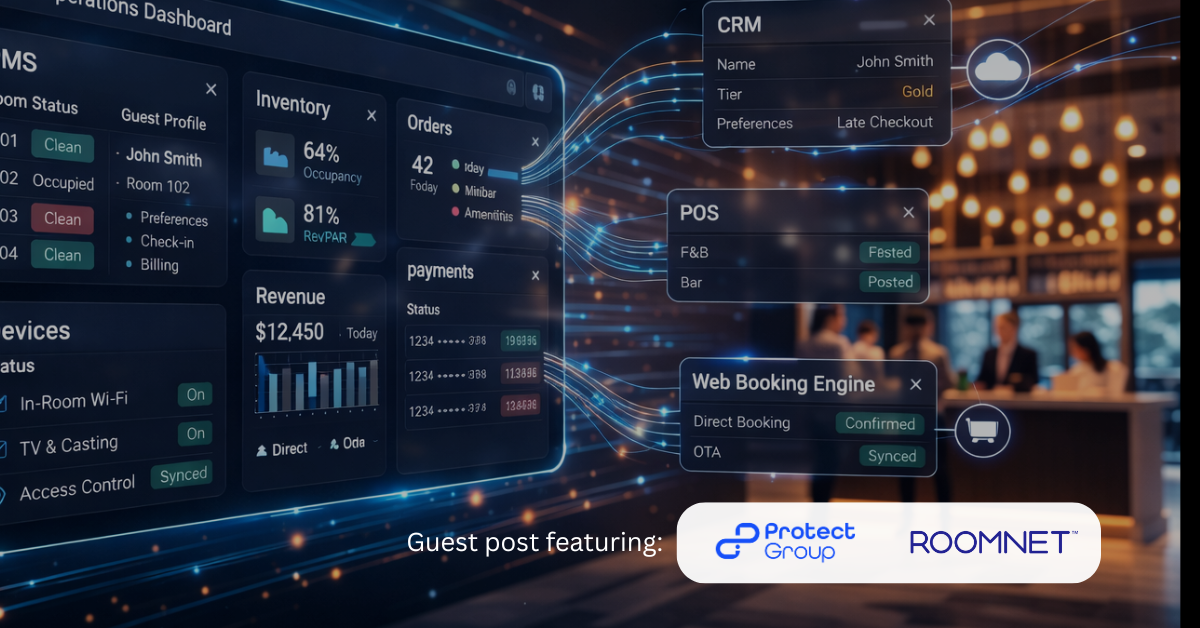
Introduction: Why connection has become the defining factor in hotel technology
For years, hotel technology decisions were driven by features, functions, and best in class tools. Today, that logic is quietly being replaced by a different priority, connection.
Hotels are no longer asking whether a system is powerful in isolation. They are asking whether it fits into a wider ecosystem, whether it shares context, and whether it supports confident operations across every touchpoint. As guest expectations rise and operational complexity increases, disconnected systems are no longer just inefficient. They actively undermine consistency, trust, and performance. What was once a technical inconvenience has become a strategic liability.
For hotel leaders, this shift fundamentally changes how technology decisions are evaluated, from choosing individual tools to designing systems that work together under real operational pressure.
This article brings together insights from Darren King, CEO of ROOMNET, and Austin Lopez, Global Strategy Lead for Hospitality at Protect Group, to explore how better connected technology ecosystems are shaping more confident, effective hotel operations.
The shift underway is not about fewer systems. It is about seamless stacks, where technology works together as a coherent whole.
Where silos still cause the most damage

One of the most persistent challenges in hospitality technology lies at the boundary between operational systems and guest facing experiences. Core platforms such as the PMS or CRM often hold the source of truth, while in room entertainment, casting, and on property digital services sit at the edge of the stack, loosely connected or updated after the fact.
From ROOMNET’s perspective, this separation is where friction most commonly appears. King notes that guest facing systems are still too often treated as standalone applications rather than as extensions of the operational environment.
As a result, routine operational changes do not always translate cleanly into the guest experience. This friction becomes especially visible when room changes, upgrades, or late checkouts are not reflected immediately across in room services, when guest profiles exist in theory but are not consistently enforced at the point of interaction, and when front of house experiences rely on batch updates or manual reconciliation to stay aligned.
The outcome is a growing gap between what the hotel knows about the guest and what the guest actually experiences. From a guest perspective, this feels like inconsistency. From an operational perspective, it introduces hidden complexity and unnecessary intervention.
When the edge becomes part of the stack

The real shift occurs when hotels move away from siloed deployments and toward context aware ecosystems. In connected environments, consistency is no longer retrofitted. It is enforced at the edge.
Rather than treating screens, devices, and digital touchpoints as passive endpoints, connected stacks allow them to become active participants in the guest journey. Guest identity, entitlements, and status are resolved once and applied everywhere the guest interacts. Operational events such as room changes or extensions are reflected instantly, without visible disruption or manual workarounds.
As King explains, the edge stops being a destination and starts becoming an expression layer. Digital touchpoints behave consistently because they share the same understanding of guest state. Context is orchestrated centrally but expressed locally, allowing experiences to feel seamless and personal without adding complexity for staff.
This matters because guests do not experience systems. They experience moments. When those moments are informed by real time context rather than delayed synchronization, the difference is immediately noticeable.
Connected commerce is part of the same story
The need for better connection does not stop at the guest experience layer. It extends directly into booking, payments, and revenue protection.
Hotels are increasingly moving away from add-on tools that sit alongside the core stack and toward solutions that embed directly into reservation and payment flows. This is where Protect Group positions its role in the ecosystem.
According to Lopez, the industry is finally breaking free from disconnected systems in favor of partners that integrate deeply without adding operational burden. Refund protection, traditionally treated as an optional extra, works best when it is designed as a native part of the booking and payment environment.
By embedding refund solutions directly into reservation and payment platforms, hotels can manage refundability within the same unified environment as rates, inventory, and guest communication. This approach supports higher conversion, reduces the financial risk of no shows, and creates a more confident booking experience for guests.
In this model, refundability is not a bolt on feature. It is a connected decision layer that supports both commercial performance and guest trust.
Why seamless stacks change how hotels operate
Taken together, these perspectives point to a broader truth. Seamless stacks are not just about better guest experiences. They fundamentally change how hotels operate.
Connected ecosystems reduce reliance on manual intervention. They limit the need for reconciliation between systems and reduce the number of moments where staff must step in to correct misalignment. When every system reflects the same operational reality, teams can act with greater confidence and speed.
This alignment also supports scale. As portfolios grow, brands expand, or operational models evolve, connected stacks are more resilient to change. They allow hotels to adapt without reintroducing fragmentation at every layer.
Perhaps most importantly, they create consistency during moments of disruption. Whether it is a last minute room change, a payment exception, or a guest request that cuts across systems, connected stacks ensure that decisions made in one place are respected everywhere else.
The role of orchestration

As hotels continue this transition, one question becomes increasingly important. It is not which system does the most, but how systems work together.
Orchestration, interoperability, and ecosystem fit are now core evaluation criteria. Hotels are learning to assess technology not just on individual capabilities, but on how well it contributes to a shared operational understanding.
This mindset shift is what separates incremental improvement from genuine transformation. Seamless stacks are built intentionally. They rely on shared context, clear ownership, and a willingness to design for long term coherence rather than short term wins.
Confidence is built between systems
The future of hospitality technology is not about eliminating complexity. It is about managing it intelligently.
As hotels move from siloed systems to seamless stacks, they gain more than operational efficiency. They gain confidence. Confidence that what the hotel knows is what the guest experiences. Confidence that systems will respond predictably to change. Confidence that growth does not require constant reinvention.
In hospitality, the experience is only as strong as the connections behind it. And increasingly, it is those connections, not individual features, that determine operational confidence.