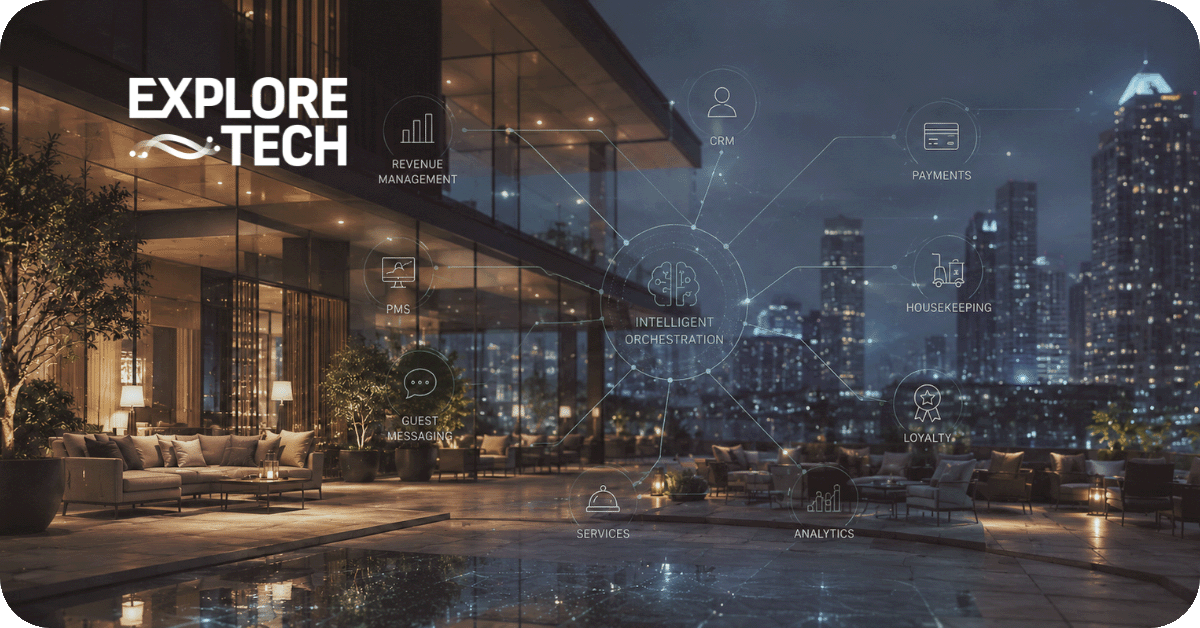
Hospitality is entering the agentic AI era
AI agents are quickly becoming one of the most talked-about topics in hospitality technology.
From AI concierges and automated guest messaging to operational copilots and intelligent upselling, the industry is moving beyond experimentation and into a new phase of AI adoption.
But while much of the conversation focuses on interfaces, assistants, and guest-facing experiences, the real challenge sits much deeper inside the hotel technology ecosystem.
The future bottleneck for agentic AI in hospitality is not the chatbot itself.
It is the infrastructure behind it.
This is a challenge already emerging across other industries. Companies like Adyen have recently highlighted how agentic commerce depends not only on AI interfaces, but on the underlying systems, data structures, integrations, and trust frameworks required to support autonomous decision-making.
Much of the emerging conversation around agentic commerce is shifting away from the interface itself and toward infrastructure readiness. That same shift is now starting to appear in hospitality as hotel operators begin evaluating whether their existing technology ecosystems can realistically support autonomous AI execution at scale.
Hospitality faces many of the same constraints.
Because once AI moves beyond answering questions and starts taking action, disconnected systems quickly become a serious operational problem.
Disconnected systems were manageable when humans sat in the middle of every workflow. Autonomous execution changes that equation very quickly.
Hospitality already has the perfect conditions for agentic AI and the perfect conditions for failure
Hospitality is one of the most operationally complex technology environments in any industry.
A single hotel environment may involve:
PMS platforms
CRS systems
RMS tools
CRM databases
POS environments
housekeeping systems
maintenance platforms
guest messaging tools
loyalty systems
payment infrastructure
middleware layers
business intelligence platforms
Most of these systems were implemented over time, often from different vendors, with varying integration depth and different levels of data consistency.
This fragmentation has always created operational friction behind the scenes. But with agentic AI, those weaknesses become far more visible and far more difficult to ignore.
Agentic AI depends on real-time data access, workflow continuity, reliable integrations, permission structures, contextual awareness, and accurate execution.
Without that foundation, AI agents struggle to operate effectively.
Recommendations become inconsistent, automation workflows break, guest experiences lose continuity, and operational trust deteriorates. In some cases, the AI simply cannot execute the task it was designed to perform.
This is why the next phase of AI adoption in hospitality is less about adding more AI tools and more about understanding whether the underlying technology ecosystem can actually support autonomous orchestration at scale.
Agentic AI will expose weak hotel tech stacks very quickly.
The industry is moving into a phase where execution matters more than experimentation.
The shift from answering questions to taking action
Most hospitality AI today still operates in a relatively controlled environment.
It responds, summarizes, recommends, and assists.
Agentic AI changes the role entirely.
Instead of simply responding to prompts, agents are designed to trigger workflows, coordinate systems, execute operational actions, update records, personalize decisions, manage sequences of tasks, and adapt dynamically to changing conditions.
This creates a major shift in operational responsibility.
A guest complaint, for example, is no longer just summarized by an AI assistant.
An agentic workflow could:
identify the issue
notify housekeeping
escalate the problem to management
trigger compensation
update the guest profile
adjust sentiment scoring
recommend a retention offer
coordinate follow-up communication
The same applies to areas like AI-driven upselling and revenue optimization.
An agent could identify guest intent, analyze availability, evaluate pricing conditions, trigger a targeted upgrade offer, adjust the offer dynamically based on inventory changes, and coordinate communication across multiple channels in real time.
At that point, the challenge is no longer the quality of the AI conversation.
The challenge becomes whether the hotel’s systems can communicate clearly enough to support reliable execution, and this is where many hospitality environments begin to struggle.
Why integrations become strategic, not technical
Historically, integrations were often treated as technical implementation requirements or procurement checklist items.
Does the system connect?
Is there an API?
Can data move between platforms?
In an agentic AI environment, those questions become far more strategic.
Integrations are no longer just technical connectors.
They become operational intelligence pathways.
And that changes the conversation entirely.
Weak integrations create weak execution.
If systems cannot exchange data consistently, agents lose context. If workflows break between platforms, automation loses reliability, and if guest data is duplicated or fragmented, personalization becomes inconsistent.
The operational impact can quickly compound.
This is especially important as hotels continue expanding their technology ecosystems.
Over the last few years, many hospitality operators adopted highly specialized solutions across multiple operational areas. While this improved capability in individual departments, it also increased ecosystem complexity.
Now, with agentic AI entering the picture, the quality of those integrations becomes far more important than the number of tools in the stack.
Hotels will increasingly need to evaluate API maturity, data consistency, workflow interoperability, latency between systems, synchronization reliability, permission management, and operational dependencies.
The future AI conversation is becoming less about features and more about orchestration.
The future of AI in hospitality may ultimately depend less on intelligence itself and more on how well systems orchestrate data, workflows, and execution across the broader technology ecosystem.
Hotels are no longer simply evaluating whether platforms have AI capabilities. They are starting to evaluate whether systems can work together well enough for AI to operate reliably across the guest journey and the operational environment.
This mirrors concerns already being discussed in sectors like retail and payments, where companies such as Adyen are emphasizing that fragmented systems, inconsistent data, and weak interoperability create serious barriers to agentic execution. Hospitality may face even greater complexity given the number of operational systems involved in a typical hotel environment.
The new hospitality AI divide
The next major divide in hospitality technology will not simply be between hotels using AI and hotels not using AI.
That conversation is already becoming outdated.
It will increasingly become the divide between:
connected ecosystems
fragmented ecosystems
Some hotel groups will be able to operationalize agentic AI effectively because their systems are structured, integrated, and aligned.
Others will struggle despite heavy AI investment because their operational foundations remain fragmented.
This is why many AI initiatives may initially appear successful in isolated use cases while failing to scale across the wider operation.
The problem is often not the AI itself. The challenge is that autonomous systems amplify infrastructure weaknesses that were previously manageable with human intervention.
In practical terms, the hotels best positioned for agentic AI will likely have stronger governance, cleaner data environments, fewer silos, clearer system ownership, more mature integrations, structured operational workflows, and better ecosystem visibility.
This is also why hospitality technology decisions are becoming increasingly interconnected.
A PMS decision impacts CRM capability, CRM quality impacts personalization, personalization impacts AI execution, and AI execution impacts operational consistency.
The entire ecosystem becomes part of the intelligence layer.
What hoteliers should focus on now
The pressure to adopt AI is increasing rapidly across hospitality.
But many hotel operators still risk focusing too heavily on interfaces instead of operational readiness.
The most important question is no longer simply, “Does this platform use AI?” The more important question is, “Can our technology ecosystem support autonomous decision-making reliably?”
For many hospitality organizations, the immediate priority should not be adding more AI tools.
It should be improving the operational conditions that allow AI systems to function properly.
That includes auditing integration depth, identifying disconnected workflows, improving data consistency, clarifying system ownership, reducing duplication across systems, evaluating API maturity, mapping operational dependencies, assessing interoperability between vendors, and understanding where orchestration currently breaks down.
This is where structured technology evaluation becomes increasingly important.
Because in an agentic environment, isolated technology decisions quickly become operational risks.
This is also where hospitality technology evaluation becomes more strategic. AI success will increasingly depend on how systems connect, how data moves, and how operational workflows execute across the broader ecosystem, not simply on which platform has the most impressive demo.
The bottom line
Agentic AI will not be powered by isolated tools. It will depend on how well hotel systems connect, communicate, and execute together.
The industry is entering a phase where infrastructure quality, integration maturity, and ecosystem orchestration may matter more than AI branding itself.
The hotels that succeed will not necessarily be the ones with the most AI tools or the loudest AI messaging.
They will be the ones with the strongest operational foundations.
As agentic AI continues evolving, hospitality technology evaluation will increasingly shift away from feature comparisons and toward ecosystem readiness.
Because ultimately, autonomous execution is only as strong as the systems supporting it.
In the agentic AI era, infrastructure quality may become one of hospitality’s biggest competitive advantages.