A hotel team decides they need a new technology solution. A few weeks later, they have vendor decks in their inbox, demos on the calendar, peer recommendations to follow up on, webinar recordings to review, and a spreadsheet that keeps getting longer. Yet they still cannot answer the one question that matters: which solution is actually the best fit?
This is the reality of modern hotel technology buying. Most purchasing decisions are made under real pressure: budget season is approaching, a system is underperforming, or a competitor has just upgraded. And so begins the familiar cycle of research, demonstrations, vendor conversations, and internal debate that too often ends with a choice made more on instinct than evidence.
The result is that technology projects in hospitality underdeliver more often than they should, not because the software is bad, but because the wrong software was selected. This article provides a practical framework to change that. Not more information to wade through, but a structured way to compare what actually matters.
Why hotel technology comparison has become harder, not easier
The hospitality technology market has expanded dramatically over the past decade. Buyers evaluating property management systems, revenue management platforms, guest engagement tools, business intelligence solutions, housekeeping software, or digital check-in technology now routinely face dozens of options in a single category. Greater choice should, in theory, produce better outcomes. In practice, it has created a new problem: evaluation paralysis.
The challenge is no longer finding technology. It is filtering, comparing, and validating it under real operational constraints, with limited time, multiple stakeholders, and no standard method for assessing vendors side by side.
One of the biggest structural obstacles is that vendors do not speak a common language. Consider a buyer researching guest engagement solutions. One provider calls itself an AI-powered guest engagement platform. Another markets guest journey orchestration. A third leads with unified experience management. All three may solve an identical business problem, but because their positioning differs, comparing them requires translation rather than straightforward evaluation. Buyers routinely spend significant time decoding marketing language before they can begin assessing actual capabilities.
Budget season makes the problem even more challenging. Most hotel teams are not evaluating a single technology category in isolation. They are simultaneously reviewing revenue optimization tools, guest engagement platforms, business intelligence solutions, finance systems, and property management technology, all within a compressed planning cycle, while operational responsibilities and commercial objectives continue uninterrupted. Information overload becomes almost inevitable long before the decision stage is reached.
The 7 dimensions every hotel technology evaluation should cover
Feature comparisons are necessary but not sufficient. A solution that checks every capability box can still fail if it does not integrate with your existing stack, cannot support your geographic footprint, or comes from a vendor whose long-term viability is uncertain. Robust hotel technology evaluation consistently covers seven dimensions.
1. Core capabilities
Start with the problem you are actually trying to solve, not the feature list, but the operational or commercial outcome you need. Ask vendors to demonstrate the specific workflows your team will use daily rather than a curated highlight reel. Where possible, request a sandbox or trial environment rather than relying on demo sessions alone, since live environments reveal friction points that polished presentations rarely show.
2. Integration architecture
Technology decisions in hospitality rarely happen in isolation, and every new system must connect to an existing ecosystem typically anchored by a PMS, CRS, or central data layer. When evaluating integrations, go beyond a simple yes or no. Ask which systems are natively connected versus which require a middleware layer, whether the integration is bi-directional or one-way, and who owns and maintains it if something breaks. Integration failures are among the most common causes of failed deployments, and validating this dimension early avoids expensive surprises at go-live.
3. Property and portfolio suitability
Not all solutions are designed for all properties. Some platforms are built for independent hotels, others for large enterprise portfolios, and performance can vary significantly between luxury environments and select-service operations. Ask vendors for reference customers with a profile similar to your own, covering property type, scale, and operational complexity. A solution that performs well for a 50-room boutique may be entirely the wrong fit for a 500-room city hotel with complex distribution requirements.
4. Deployment model and technical requirements
Cloud-based, on-premise, or hybrid? Subscription, license, or transaction-based pricing? Single-property or multi-property architecture? These questions carry direct implications for IT resource requirements, implementation timelines, and total cost of ownership, and they should be clarified before any commercial negotiation begins.
5. Geographic support and local market knowledge
A vendor's ability to support your operations matters as much as its product capabilities. If your properties span multiple regions, confirm that the vendor has genuine local presence rather than a reseller relationship in those markets, and ask specifically about language support, regional compliance requirements, and time-zone coverage for customer success and technical support teams.
6. Security, compliance, and data governance
Data protection obligations vary across markets, and vendors must be able to navigate that complexity on your behalf. Request current security certifications such as SOC 2 or ISO 27001, and ask specifically how the vendor handles data residency, breach notification, and third-party data sharing. For any system that processes guest data, this dimension is non-negotiable.
7. Vendor viability and long-term partnership
Technology procurement is a product decision and a relationship decision simultaneously. The vendor selected today needs to be a credible partner in three to five years. Evaluate funding stability and ownership structure, product roadmap transparency, customer retention rates, the quality and accessibility of the support model, and the vendor's track record of successful implementations at comparable properties.
Why spreadsheets are failing buyers
Spreadsheets were a reasonable evaluation tool when decisions involved three or four vendors and a limited set of criteria. That is no longer the reality. A modern hotel technology evaluation can involve dozens of potential solutions within a single category, hundreds of comparison data points across the seven dimensions above, multiple internal stakeholders with different priorities, integration dependencies that evolve as new information surfaces, and evaluation criteria that shift as the team learns more about the market.
At this level of complexity, spreadsheets become a liability rather than an asset. Version control breaks down, stakeholder inputs become inconsistent, and decision criteria drift as the document passes between teams. What starts as a structured exercise frequently becomes an administrative burden, and critical details get missed in the process.
The consequences are real. An integration requirement overlooked. A regional support gap not discovered until implementation. A capability assumed rather than validated. These are not edge cases. They are among the most common reasons technology projects in hospitality underdeliver, and they are largely avoidable with a more structured evaluation approach.
What structured comparison actually looks like
The organizations making the best technology decisions are not necessarily the ones with access to the most information. They are the ones with the most consistent evaluation process, and that distinction matters more than most buyers realize.
Structured comparison means applying the same evaluation criteria to every solution under consideration, capturing vendor responses in a standardized format, and separating objective data (integrations, certifications, deployment options) from subjective assessment (demo quality, cultural fit, support responsiveness). It means making decision criteria explicit before vendor conversations begin rather than constructing them retrospectively around the option that made the best impression. And it means involving all relevant stakeholders in a shared evaluation environment rather than a chain of forwarded emails and disconnected conversations.
This shift from information gathering to structured evaluation is the single most impactful improvement most hotel technology buyers can make, and it does not require more time. It requires better organization of the time already being spent.
How the ExploreTECH Comparison Tool supports better decisions
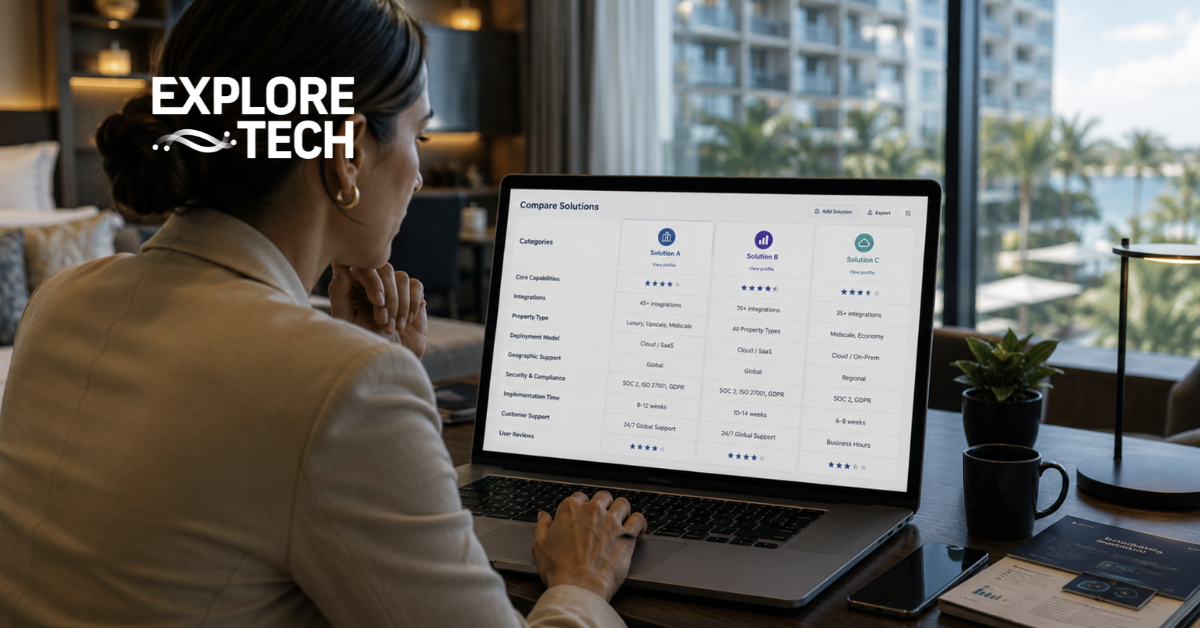
Building a structured evaluation process from scratch takes time that most teams simply do not have, particularly during budget planning cycles when multiple technology categories are under review simultaneously. ExploreTECH's side-by-side Comparison Tool is designed to remove that friction.
Rather than opening dozens of browser tabs and manually translating vendor marketing into comparable information, buyers can use the tool to compare solutions across standardized capability dimensions in a single view, assess integration compatibility with existing hotel technology stacks, filter by property type, portfolio size, geographic support, and deployment model, export structured comparison reports for stakeholder review, and access vendor information presented in a consistent and comparable format.
The goal is not to replace human judgment. It is to create a consistent framework that allows buyers to evaluate solutions objectively, involve stakeholders more effectively, and arrive at decisions with greater confidence and less wasted effort.
For teams reviewing multiple technology categories at once, this consistency compounds. The same structured approach applied across revenue management, guest engagement, business intelligence, and property management creates a stronger foundation for technology decision-making across the entire organization, because better technology decisions rarely come from gathering more information. They come from making better sense of the information already available.
Frequently asked questions
What should hotels compare when evaluating technology solutions?
Effective evaluation covers seven dimensions: core capabilities, integration architecture, property and portfolio suitability, deployment model and technical requirements, geographic support, security and compliance, and vendor viability. Feature comparisons alone are not sufficient.
Why do hotel technology projects underdeliver?
Most underperformance is not caused by poor software. It results from selecting the wrong software for a specific operational context. The most common causes are undiscovered integration gaps, regional support limitations identified only after implementation, and capability assumptions that were never validated during evaluation.
How many vendors should hotels evaluate?
There is no fixed number, but the quality of the evaluation matters more than the quantity of vendors assessed. A rigorous comparison of five well-matched solutions will produce a better outcome than a surface-level review of twenty, particularly when evaluation criteria are defined clearly before vendor conversations begin.
When should the technology evaluation process start?
Ideally, evaluation begins eight to twelve weeks before a decision is needed. Starting ahead of budget season allows time to validate integrations properly, speak with reference customers, and avoid the compressed timelines that lead to decisions made under pressure rather than on evidence.
How does the ExploreTECH Comparison Tool help?
The ExploreTECH side-by-side Comparison Tool provides structured, standardized vendor information across key evaluation dimensions, enabling buyers to compare solutions consistently without building a framework from scratch. It supports faster shortlisting, more objective assessment, and cleaner stakeholder communication throughout the decision process.
Ready to compare solutions more effectively?
Technology decisions are too important to rely on scattered notes, disconnected spreadsheets, and vendor impressions alone. Whether you are evaluating a new PMS, a revenue management platform, a guest engagement solution, or a business intelligence tool, a structured comparison process helps you move faster and make more confident decisions.
Use ExploreTECH's Comparison Tool to evaluate hospitality technology side by side, compare capabilities and integrations across standardized criteria, and generate exportable reports that support stakeholder discussions and procurement decisions.
Explore. Compare. Decide.
The bottom line
The hospitality industry does not have an information problem. Buyers can access more technology data today than at any point in history, and that access will only increase as the market continues to expand.
The challenge is turning that information into confident decisions, systematically, under time pressure, with multiple stakeholders and competing priorities. The organizations that consistently get this right are not the ones with the longest shortlists or the most vendor meetings. They are the ones that bring structure to the process early and apply it consistently throughout.
Technology decisions are not won by gathering more information. They are won by making better sense of the information you already have.
Ready to move beyond spreadsheets and vendor decks?
Compare hospitality technology solutions side by side, evaluate capabilities and integrations in a structured format, and build stronger shortlists with greater confidence.
Try the ExploreTECH Comparison Tool today.