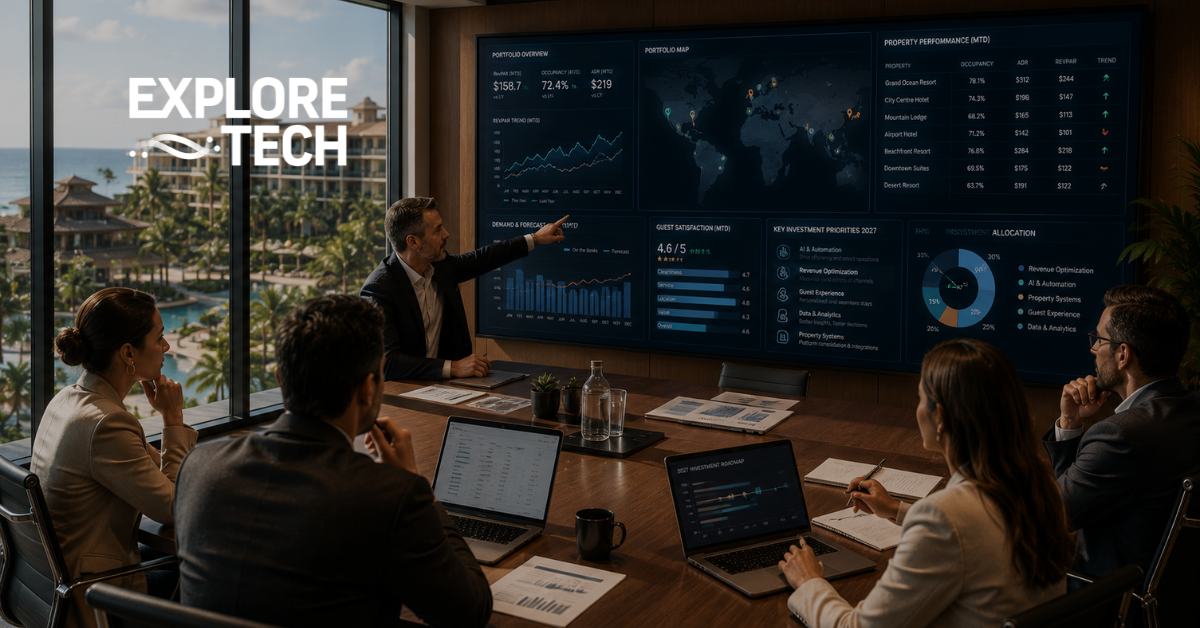
As hotel technology budget planning begins across the industry, hospitality leaders are evaluating which investments will have the greatest impact on operations, revenue, guest experience, and long-term business performance.
From AI and automation to revenue optimization and platform consolidation, technology priorities are shaping budget discussions for 2027. While every organization faces unique challenges, several common themes are emerging as hotel groups and independent operators review their technology strategies for the year ahead.
The reality is that hotel technology decisions have become increasingly complex. Teams are navigating hundreds of solutions across dozens of categories, often while balancing operational requirements, financial constraints, integration considerations, and stakeholder expectations.
As budget season gets underway, the focus is shifting from simply identifying new technologies to determining which investments can deliver measurable business outcomes.
Key priorities shaping hotel technology budgets
Operational efficiency remains a top priority
AI moves from experimentation to business outcomes
Platform consolidation gains momentum
Data visibility becomes a strategic requirement
Revenue optimization continues to evolve
Guest experience investments mature
Cybersecurity and governance rise up the agenda
Why visibility matters before procurement begins
How hotels can prepare for technology budget discussions
Operational efficiency remains a top priority
Despite significant digital transformation across the hospitality industry, operational efficiency continues to be one of the strongest drivers of technology investment.
Hotels are still under pressure to do more with limited resources. Labour shortages, rising operational costs, and increasingly complex guest expectations mean that teams are constantly looking for ways to work smarter.
As a result, many technology investments are being evaluated through a simple lens: can this solution reduce manual work and improve productivity?
This focus spans multiple departments, including:
Front office operations
Housekeeping
Finance and accounting
Revenue management
Sales and marketing
Guest services
Hotels are increasingly prioritizing solutions that automate repetitive tasks, improve workflow efficiency, reduce administrative burdens, and support faster decision-making.
The objective is no longer simply to digitize processes. Most organizations have already invested in digital tools. The focus now is on identifying operational bottlenecks and removing friction between systems, teams, and workflows.
AI is moving from experimentation to business outcomes
Artificial intelligence remains one of the most discussed topics in hospitality technology, but buyer expectations are becoming far more sophisticated.
Over the past two years, many hotel organizations have experimented with AI-powered solutions. As budget discussions begin for 2027, however, hotel leaders are becoming more selective.
The question is no longer:
"Do we need AI?"
Instead, it has become:
"What measurable business outcome will AI deliver?"
This shift is driving greater scrutiny around technology investments and expected returns.
Areas attracting significant interest include:
Revenue optimization
AI-driven forecasting, pricing recommendations, market intelligence, and demand prediction continue to gain momentum. Hotels are increasingly looking for technologies that improve forecasting accuracy and help revenue teams react faster to changing market conditions.
Guest engagement
AI-powered communication tools are helping hotels deliver more personalized interactions while improving response times and reducing pressure on operational teams.
Operational intelligence
Many organizations are exploring AI solutions that support reporting, predictive analytics, anomaly detection, and business intelligence.
The most successful AI investments are increasingly those that demonstrate clear contributions to revenue growth, operational efficiency, cost reduction, or guest satisfaction.
Platform consolidation is gaining momentum
Another major trend shaping hotel technology strategy is consolidation.
Over time, many organizations have accumulated a large collection of systems across different departments and properties. While these investments often solve specific challenges, they can also create complexity.
Disconnected platforms frequently lead to:
Duplicate data
Reporting challenges
Integration costs
Operational inefficiencies
Governance concerns
As a result, many hotel groups are evaluating opportunities to simplify their technology ecosystems.
This is driving increased interest in:
Enterprise platforms
Unified technology ecosystems
Vendor consolidation initiatives
Integrated operating environments
Centralized reporting structures
For multi-property organizations in particular, consolidation can provide greater visibility, consistency, scalability, and control.
Technology discussions are increasingly moving beyond individual solutions and toward broader ecosystem decisions.
The question is becoming less about which product is best and more about which technology environment best supports long-term business goals.
Data visibility is becoming a strategic requirement
Hotels generate enormous volumes of data every day.
Reservations, guest interactions, operational metrics, financial performance, marketing campaigns, distribution channels, and commercial activities all contribute valuable information.
The challenge is transforming that information into actionable insight.
As a result, data visibility has become a strategic priority for many organizations entering budget season.
Executives increasingly want:
Real-time reporting
Better forecasting
Faster access to information
Improved decision support
Greater operational transparency
Technology investments are now frequently evaluated based on their ability to contribute to broader data strategies.
Questions around data ownership, integration quality, reporting flexibility, and business intelligence capabilities are becoming increasingly important during vendor evaluations.
Organizations recognize that technology creates the greatest value when it enables better decisions across the business.
Revenue optimization continues to evolve
Revenue management remains a critical technology category, but the scope of commercial decision-making continues to expand.
Today's hospitality organizations are increasingly connecting revenue optimization with broader business performance.
Technology investments are supporting:
Forecasting accuracy
Dynamic pricing
Demand intelligence
Market analysis
Ancillary revenue generation
Commercial planning
Revenue teams are looking for solutions that not only improve pricing decisions but also provide greater visibility into market dynamics and future demand.
The integration of revenue management, finance, distribution, guest engagement, and business intelligence systems is becoming increasingly important.
As a result, many organizations are investing in technologies that support more connected and data-driven commercial strategies.
Guest experience investments continue to mature
Guest experience remains an important area of focus, but investment priorities have evolved significantly.
Hotels are increasingly looking for technologies that improve guest satisfaction while also delivering operational and commercial benefits.
This includes solutions that support:
Digital guest services
Mobile communication
Personalization
Self-service experiences
Mobile ordering
Upselling opportunities
Guest journey orchestration
The most attractive investments are often those that support multiple business objectives simultaneously.
Rather than evaluating guest-facing technologies in isolation, hotel leaders are increasingly considering how these solutions contribute to operational efficiency, revenue generation, and long-term guest loyalty.
Cybersecurity and governance are moving higher on the agenda
Technology evaluation is no longer focused solely on features and functionality.
As technology ecosystems become increasingly connected, cybersecurity and governance are becoming more important considerations during procurement and budgeting discussions.
Organizations are asking more detailed questions about:
Data protection
Security certifications
Compliance requirements
Access controls
Vendor governance
Business continuity planning
This trend is particularly visible among enterprise operators and multi-property organizations where risk management and regulatory compliance are critical priorities.
Technology providers that can demonstrate strong security and governance capabilities are increasingly viewed as lower-risk long-term partners.
Technology investments must be easier to justify
Economic uncertainty continues to influence hospitality investment decisions.
As a result, technology providers face growing pressure to demonstrate measurable value.
Hotel leaders increasingly expect:
Clear business cases
Quantifiable outcomes
Defined implementation plans
Realistic timelines
Strong adoption strategies
Technology investments are no longer approved simply because they are innovative.
Buyers want confidence that solutions will deliver measurable improvements and align with broader organizational goals.
The ability to demonstrate return on investment has become a key differentiator during evaluation processes.
Why visibility matters before procurement begins
One of the most important realities of budget season is that many technology decisions begin long before a formal procurement process starts.
Before shortlists are created and requests for proposals are issued, buyers are already researching categories, reading industry content, attending webinars, speaking with peers, and evaluating potential solutions.
By the time a formal buying process begins, many organizations have already developed a strong understanding of the technologies they want to explore further.
This means that visibility during planning and budgeting discussions is often just as important as visibility during active procurement.
The solutions that consistently appear throughout the research journey frequently gain a significant advantage when final decisions are made.
For technology providers, this highlights the importance of maintaining visibility through educational content, thought leadership, industry participation, and structured product information well before budget approvals take place.
How hotels can prepare for technology budget discussions
While every organization approaches budgeting differently, several best practices can help create more effective technology planning processes.
1. Start with business objectives
Technology should support business outcomes, not the other way around.
Clearly define the operational, financial, and guest experience goals that technology investments are expected to support.
2. Audit existing technology
Understand what systems are currently in place, where gaps exist, and where overlap or inefficiencies may be creating unnecessary complexity.
3. Identify operational bottlenecks
Focus on the processes and workflows that create the greatest challenges for teams today.
4. Prioritize measurable outcomes
Define success criteria before evaluating solutions. This creates a stronger framework for comparison and investment decisions.
5. Build a structured evaluation process
With hundreds of technology options available, structure becomes increasingly important. Establishing clear evaluation criteria can help teams compare solutions more effectively and make decisions with greater confidence.
Frequently asked questions
What technology investments are hotels prioritizing for 2027?
Hotels are increasingly prioritizing AI, automation, revenue optimization, data analytics, platform consolidation, cybersecurity, and guest experience technologies.
How does budget season affect hotel technology purchasing decisions?
Budget season is often when hotel teams evaluate operational priorities, identify technology gaps, and determine which investments will be funded in the following year.
Why are hotels consolidating technology platforms?
Many organizations are looking to reduce complexity, improve data visibility, streamline operations, and reduce integration challenges across multiple properties.
What role does AI play in hotel technology planning?
Hotels are increasingly evaluating AI solutions that support forecasting, pricing, guest engagement, reporting, and operational decision-making.
The bottom line
As hotels begin planning for 2027, technology investment priorities are becoming increasingly focused on outcomes rather than features.
Operational efficiency, AI-driven decision support, platform consolidation, revenue optimization, data visibility, cybersecurity, and guest experience continue to shape budgeting discussions across the industry.
At the same time, buyers are demanding greater clarity, stronger business cases, and more confidence throughout the decision-making process.
The challenge facing many organizations is not a lack of available technology. It is navigating a growing number of options while maintaining alignment with operational goals, financial objectives, and long-term strategy.
In an increasingly complex technology landscape, the organizations that succeed will be those that bring structure, discipline, and strategic focus to their technology decisions long before procurement formally begins.