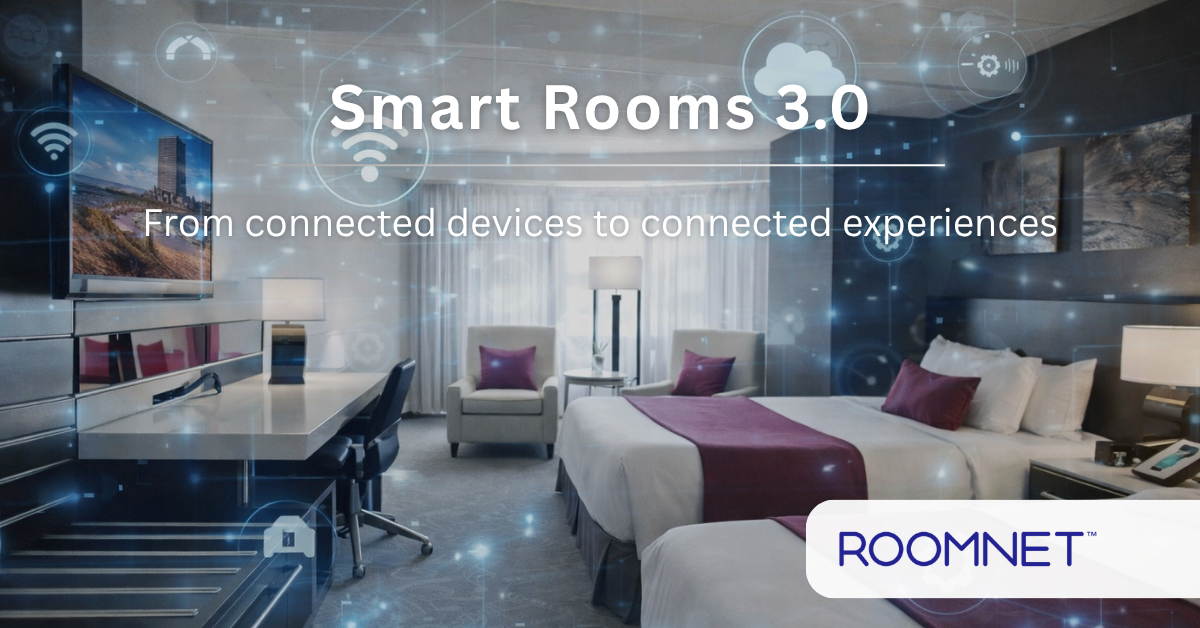
The idea of the “smart room” isn’t new. For years, it’s been part of how hotels signal innovation, adding smart TVs, tablets, voice assistants, and automation to enhance the guest experience.
But somewhere along the way, something became clear. Adding more technology didn’t always make the experience better.
In many cases, it did the opposite.
Guests were faced with multiple interfaces, inconsistent controls, and systems that didn’t quite work together. What looked advanced on paper often felt fragmented in practice.
Today, the conversation is shifting.
As hotels navigate a more uncertain operating environment, the focus is shifting toward technologies that don’t just add features, but actively simplify operations and improve the guest experience.
Across the industry, hotels are beginning to rethink what the smart room actually means, moving away from individual features and toward something more connected, more intuitive, and more aligned with how guests already interact with technology in their daily lives.
To explore how this evolution is taking shape, ExploreTECH spoke with Darren King, CEO of ROOMNET, whose work in in-room platforms sits at the intersection of guest experience, infrastructure, and system integration.
As King puts it:
“A few years ago, the smart room was largely defined by individual features... today the concept has shifted from devices to integration and orchestration.”
And that shift is starting to reshape not just the room, but how hotels think about technology more broadly.
What’s emerging now is not a room filled with smart devices, but a room that behaves more like a connected environment.
Behind the scenes, systems are beginning to share context in ways that were not previously possible. The room can recognise when a guest has checked in, adjust settings automatically, and respond to changes throughout the stay. Lighting, climate, and entertainment are no longer isolated controls, but part of a wider ecosystem that reflects both operational inputs and guest preferences.
“A truly connected guest room is part of a broader digital ecosystem where systems share context and data,” King explains.
This idea of context is important. It means the room is no longer static. It becomes responsive, shaped by who the guest is, where they are in their journey, and what is happening operationally behind the scenes.
When this works well, it doesn’t feel like technology at all. It feels like ease.
At the same time, guest expectations are being shaped far beyond the hotel environment.
People arrive with deeply ingrained digital habits. How they stream content, how they interact with devices, and how they expect systems to remember preferences. Hotels are no longer defining these expectations. They are responding to them.
Casting, for example, has quickly moved from a nice-to-have to a baseline expectation. Guests want to access their own content instantly, without friction or complicated logins. But the real evolution goes further than casting itself.
The room is beginning to align with the guest’s personal ecosystem. Interfaces feel familiar. Preferences persist. Devices connect seamlessly. The boundaries between personal and in-room technology start to blur.
This is where Smart Rooms 3.0 begins to take shape, not as a collection of features, but as a continuation of the guest’s digital life.
Within this shift, the role of the in-room interface has quietly but significantly changed.
What was once a secondary touchpoint, often underutilized or treated as an add-on, is now becoming central to the experience. In many properties, the TV or in-room platform is evolving into the primary gateway through which guests interact with both the room and the hotel.
Entertainment, room controls, service requests, dining, and communication all begin to converge in one place.
As King notes:
“Increasingly, this means treating the TV or in-room digital platform as a central hub rather than just an amenity.”
This shift has practical implications. A well integrated interface reduces friction, simplifies navigation, and makes the experience more intuitive. Instead of asking the guest to move between systems, it brings everything together into a single, coherent interaction layer.
And importantly, it creates a new opportunity for hotels, not just to inform, but to engage.
Because beyond experience, there is also a clear commercial layer to the connected room.
When the in-room platform is integrated with guest data and operational systems, it becomes a powerful channel for delivering relevant, timely offers. Dining, upgrades, services, and experiences can be surfaced in context, rather than pushed generically.
This is where the room begins to play a more active role in revenue generation.
Not through interruption, but through relevance.
At the same time, operational efficiency improves. Service requests are streamlined. Communication becomes more direct. Staff can respond with better context. The room becomes not just a guest facing environment, but part of the hotel’s operational infrastructure.
Of course, not every smart room delivers on this promise.
In many cases, hotels have invested heavily in technology, only to find that the experience still feels disjointed. Devices are impressive in isolation, but disconnected in practice.
King sees this pattern frequently:
“Hotels most often get smart room investments wrong by focusing on features rather than integration and ease of use.”
It’s an easy trap to fall into. New technologies are deployed to solve specific problems or add visible innovation, but without a clear integration strategy, they create more complexity than value.
The result is a fragmented experience, one that the guest has to navigate, rather than one that supports them.
And ultimately, guests are not evaluating the technology itself.
“Guests rarely judge technology by how advanced it is… they judge it by whether it works reliably and intuitively.”
This is a simple point, but one that continues to shape how smart room strategies are evolving.
As a result, integration is no longer a technical consideration. It has become a strategic priority.
Hotels are increasingly thinking in terms of ecosystems rather than individual solutions. They are asking how systems connect, how data flows, and how the guest experience remains consistent across every touchpoint.
This includes the in-room environment, but extends far beyond it, into PMS, CRM, revenue systems, guest apps, and operational platforms.
The room is no longer a standalone experience. It is part of a connected architecture.
And within that architecture, the quality of the experience is defined not by the strength of individual components, but by how well they work together.
Looking ahead, this evolution is set to accelerate.
Over the next three to five years, in-room technology is expected to become more adaptive, more personalised, and more closely aligned with the way guests already live and interact with technology.
King points to three key developments shaping this next phase: AI driven personalisation, deeper mobile integration, and platform based guest experiences built around familiar ecosystems.
“AI will enable rooms to adapt by learning guest preferences, responding to operational events, and presenting relevant services or content.”
This is where the concept of the smart room begins to evolve into something more dynamic.
Instead of pre set configurations, rooms will increasingly respond in real time, adjusting based on behaviour, preferences, and context. The experience becomes less about control, and more about anticipation.
At the same time, platforms built around ecosystems like Apple and Google are helping to bridge the gap between personal and in-room technology, making interactions more natural and reducing the need for guests to adapt to new systems.
For hotel teams, this changes the nature of decision making.
The question is no longer what technology should we add to the room, but rather how should the room function within our broader technology ecosystem.
This requires a different approach, one that prioritises integration, scalability, and experience consistency over standalone innovation.
It also requires closer alignment between teams. IT, operations, commercial, and guest experience functions all play a role in shaping how the room performs, both technically and experientially.
In this sense, the smart room becomes a cross functional initiative, not just a technology upgrade.
Because ultimately, the success of the smart room won’t be measured by how much technology it contains.
It will be measured by how little the guest has to think about it.
When systems are connected, interfaces are intuitive, and experiences are consistent, the technology fades into the background. What remains is a stay that feels seamless, responsive, and aligned with the guest’s expectations.
Or, as King puts it:
“The guest room will feel less like a collection of devices and more like an adaptive digital environment that responds intelligently throughout the stay.”
For hotels looking to move in this direction, the next step is not just identifying individual solutions, but understanding how the right technologies connect within a broader ecosystem.