If you are choosing business intelligence software for a hotel or a group, the hard part is not the decision. It is everything that comes before it: tracking down who actually operates in this space, working out what each product really does, and forcing eight different sales decks into something you can compare line by line. Most teams lose weeks there before they evaluate anything.
That work is already done. ExploreTECH has researched the hospitality business intelligence landscape and structured 76 verified solutions against the same fields, so you can start from a comparison instead of starting from a blank page. Verified means the details have been checked rather than taken from a vendor's own marketing, which is the difference between evaluating a product and reading a brochure. That is what an intelligence ecosystem does: it turns a fragmented market into a structure you can actually navigate, before any transaction happens.
This guide is for the people who own that call, CIOs, CTOs, IT leaders, asset managers and commercial directors. It covers the eight subcategories business intelligence breaks into, what each one actually decides, and how to build a shortlist inside them.
What are you actually deciding when you buy hotel BI?
You are deciding which commercial question to solve first, and refusing to let a vendor answer that for you. The most expensive BI mistake is buying a broad platform to cover a specific gap, then paying for six modules to use one. Name the decision first: benchmarking, pricing intelligence, guest sentiment, customer data, or profit visibility.
The discipline is sequencing. A revenue leader chasing rate parity needs rate and market intelligence, not a reputation suite. An asset manager who wants GOPPAR visibility across a portfolio needs financial planning and benchmarking, not a guest-survey tool. The framework above is the order that keeps a BI purchase from sprawling: name the decision, match it to one subcategory, evaluate on four factors, then shortlist only verified vendors in that subcategory. Everything after this section is how to execute those four steps.
Which BI subcategories exist, and what does each one decide?
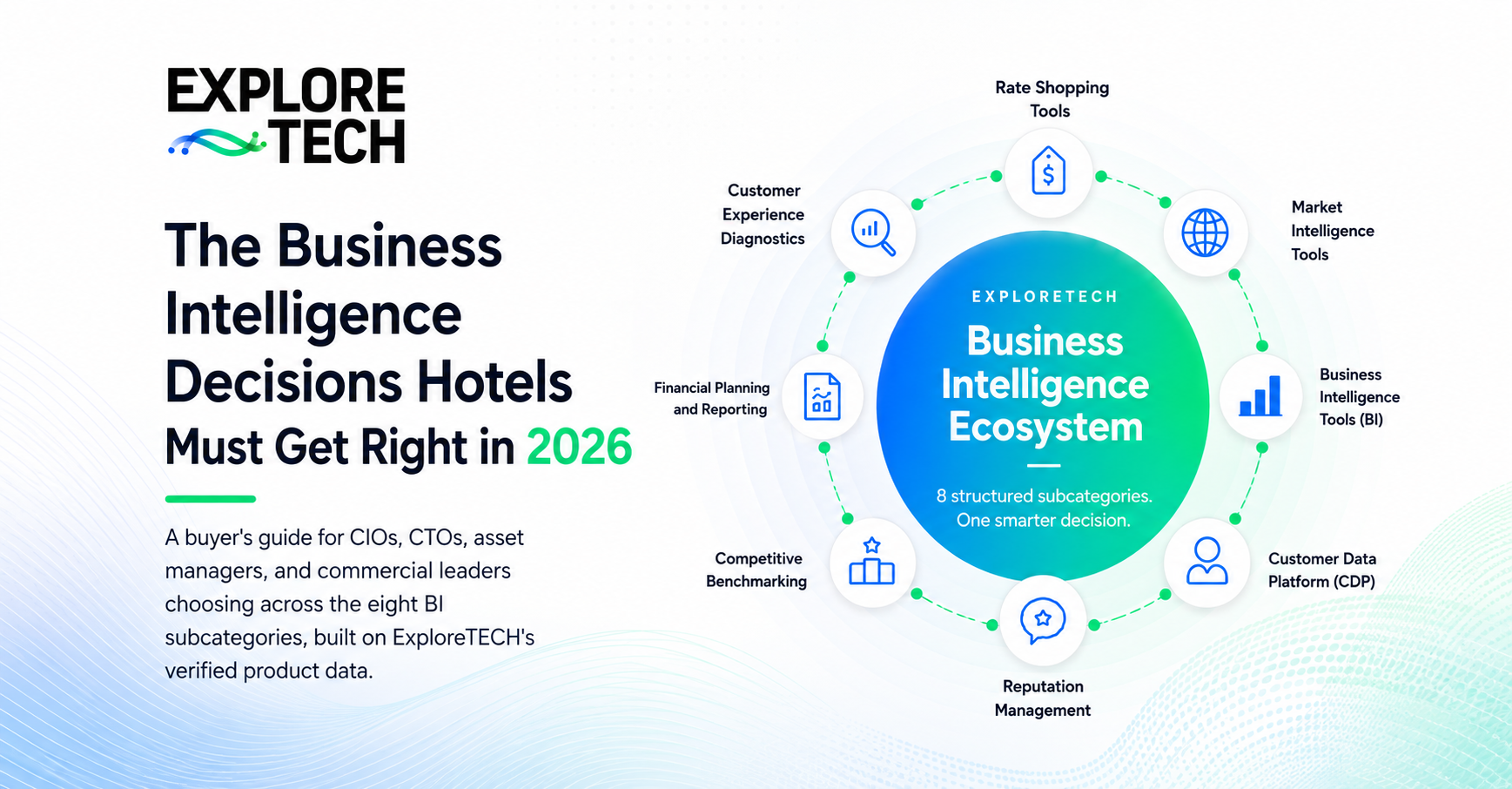
Hotel business intelligence on ExploreTECH breaks into eight subcategories, each mapped to a distinct commercial decision. Treat them as separate buys with separate evaluation criteria, not as features of one dashboard. The map below is the whole category in a single view, which is what an intelligence ecosystem is for: the structure, the decision each part answers, and the solutions already verified inside it.
Business Intelligence Tools consolidate your internal systems into dashboards and automated reporting. This is the broadest subcategory and the right starting point when the problem is "our data lives in six places." Verified solutions include HotelIQ, Avalon Analytics, hotellab and Juyo Analytics.
Rate Shopping Tools decide pricing moves by watching competitor rates and live demand, with Lighthouse, Hotellistat and RateIntel.io among the verified options. Market Intelligence Tools answer the wider strategic question using destination and demand signals, where Mabrian, Cendyn and IDeaS operate. The two are often confused, and buying one when you needed the other is a common and expensive error. If pricing is the decision you are closest to, our guide to choosing a revenue management system covers the adjacent buy.
Reputation Management turns reviews and guest sentiment into a usable data source rather than a monthly summary someone reads and forgets. TrustYou, GuestRevu and Revinate sit here. Customer Experience Diagnostics is the sharper, more specialist neighbour, using structured surveys and feedback to locate exactly where the guest experience breaks down.
Customer Data Platform (CDP) unifies guest data so it can drive segmentation and personalization, with dailypoint, Bookboost and Omniboost among the verified solutions. This is the subcategory most often bought too late, after three years of guest data has already been fragmented across systems. It sits close to CRM, and our piece on hotel CRM and customer loyalty is worth reading alongside it.
Financial Planning and Reporting connects commercial performance to the P&L for owners and asset managers moving past RevPAR toward GOPPAR, served by Fairmas and Otelier. Competitive Benchmarking answers how you actually performed against your comp set, with STR, HotStats and Hotel Benchmark. Most asset managers need both, since internal profit visibility means little without external context.
Every solution named here is verified on ExploreTECH and structured on the same fields, so they can be compared directly rather than read one brochure at a time. Each subcategory above links through to its full field, where you can filter by sales coverage region, business type and AI capability, and open any product profile for the underlying detail.
What our own coverage shows about this category
Two patterns stand out in ExploreTECH's verified BI data, and both change how you should build a shortlist.
This is a specialist's category. The 76 verified products come from 50 vendors, and 35 of those vendors have exactly one verified BI product. Seven in ten are specialists rather than suites. If you are hoping one purchase covers several subcategories, the market is not built that way, and the vendors who do span multiple areas are the exception rather than the norm.
The exceptions are worth knowing. Eleven vendors operate across two or more BI subcategories. Cendyn and Blastness each cover three, spanning business intelligence, market intelligence and rate shopping. Hotellistat and HotelRunner also cover three. Otelier and Fairmas bridge business intelligence and financial planning. That matters because consolidating two adjacent subcategories with one vendor reduces integration work, but narrows your options in each. It is a genuine trade-off, and it is easier to make deliberately than to discover afterwards.
Which subcategory should you evaluate first?
Evaluate first where your commercial pain is sharpest, and let the role you sit in decide the order. The eight subcategories solve genuinely different problems, so the right starting point is rarely the same for two people in the same hotel group.
A CIO consolidating fragmented reporting starts with Business Intelligence Tools, the broadest subcategory on the map above. An asset manager chasing GOPPAR visibility starts with Financial Planning and Reporting, then adds Competitive Benchmarking for context against the comp set. A commercial director defending rate position starts with Rate Shopping and Market Intelligence. In each case the shortlist is already assembled and structured on the same fields, so the work is choosing between options rather than finding them.
This is also why sequencing beats bundling. A group that buys one broad platform to cover all eight ends up with a tool that is adequate everywhere and excellent nowhere, and the modules nobody uses still appear on the invoice. Buying one subcategory properly, then extending, keeps the spend tied to a decision someone actually owns.
How should CIOs and commercial leaders evaluate a BI vendor?
Evaluate every BI vendor on four factors before price. These are the questions that separate a tool that survives implementation from one that stalls.
First, integration reality: confirm it connects to your specific PMS and RMS, not "most systems." Second, level of aggregation: a single property and a 40-hotel group need very different things, and portfolio roll-up is where single-property tools quietly fail. Third, data ownership: know who owns the data and whether you can export it if you leave. Fourth, verification: in a category full of similar-sounding dashboards, a product whose details have been independently checked rather than self-reported is a materially safer starting point, so make verified status a filter rather than an afterthought.
Which verified vendors should be on your shortlist?
Shortlist only verified vendors in the subcategory you named, then compare them side by side. The map earlier in this article already pairs every subcategory with the verified solutions inside it, so you can move straight from "which subcategory" to "which names" without going back out to the open market.
Once your shortlist is set, use ExploreTECH's side-by-side comparison tool to evaluate them on the four factors above before you book a single demo. Every product profile carries the same structured fields, integrations, launch year, deployment regions, company size and last verification date, so the comparison is like for like rather than brochure against brochure. That is the pre-transaction footing that separates a real evaluation from a sales-led one.
If the decision is larger than a single tool, or you are weighing a wider stack change, ExploreTECH's advisory services and research reports go a level deeper than a product comparison can.
FAQ
What is the first decision to make when buying hotel BI? Name the single commercial question you need answered, benchmarking, pricing, guest sentiment, customer data, or profit visibility, and map it to one of the eight subcategories. Buying a broad platform before naming the decision is the most common and most expensive mistake.
How many hotel BI products are verified on ExploreTECH? ExploreTECH holds 76 verified business intelligence products across the eight subcategories. Verified means the product's details have been checked rather than taken from a vendor's own marketing.
Are all eight subcategories structured the same way? Yes. Every verified solution is mapped to the same fields regardless of subcategory, which is what makes a like-for-like comparison possible. Business Intelligence Tools is the broadest of the eight, but a shortlist in any subcategory can be evaluated on identical criteria.
What should asset managers prioritize versus commercial leaders? Asset managers usually prioritize financial planning and benchmarking for profit visibility. Commercial and revenue leaders usually prioritize rate shopping and market intelligence for pricing decisions. Naming the role's core decision keeps the two from buying each other's tools.
How should we evaluate a BI vendor before pricing? On four factors: PMS/RMS integration, level of aggregation (single property versus portfolio), data ownership and exportability, and verification status. Price is the fifth question, not the first.
Is benchmarking the same as business intelligence? No. Competitive benchmarking is one of eight BI subcategories. It answers how you performed against a comp set, while the broader BI Tools subcategory consolidates your own systems into dashboards and reporting.