
Resort tech is joining up dining, rooms, and teams
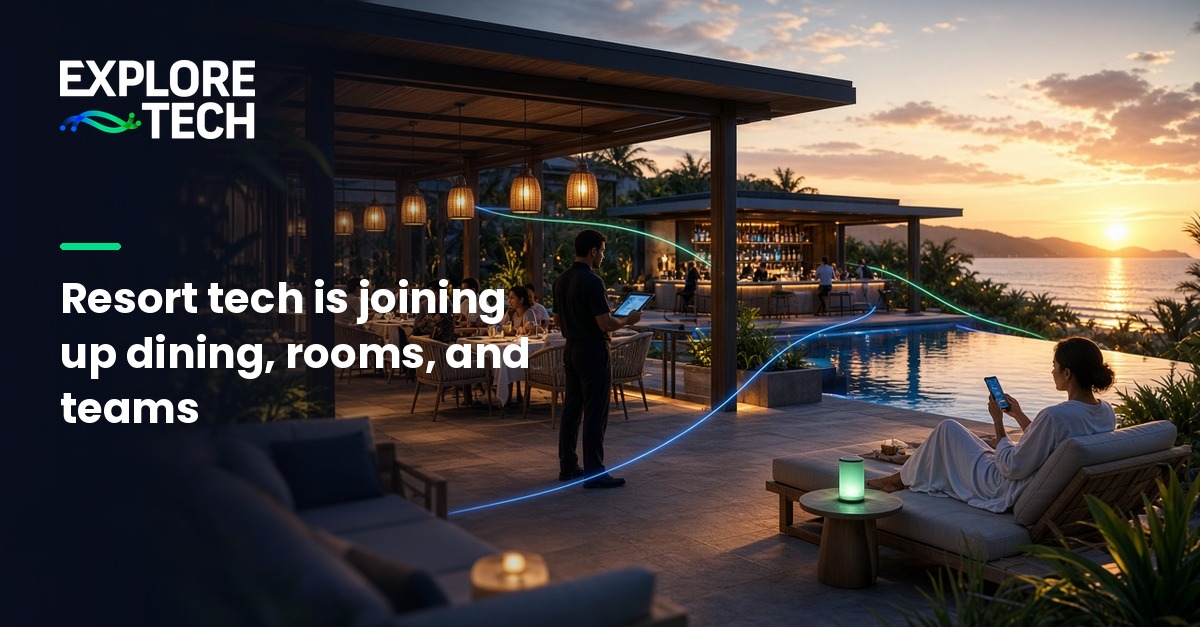
Resort tech is joining up dining, rooms, and teams
Within the first three months of a new
mobile ordering rollout, Wyndham Grand Orlando Resort Bonnet Creek received
more than 350 digital food and beverage orders a month, and on busy evenings
its kitchen handled as many as 50 in-room dining orders while also serving
other outlets. That result, from a 400-room resort with five outdoor pools,
four restaurants, and neighboring timeshare towers, sets the tone for this
week's roundup. Across dining, property management, daily operations, and the
last morning of the stay, we look at how connected systems help resorts sell
more and work with less friction.
This roundup covers October 30 to November
16, 2026, and includes an Eleanor departure-product update from October 9.
Mobile ordering is becoming a resort revenue channel
IRIS published a case study on Bonnet Creek,
which replaced a mobile ordering platform that had become unreliable. Guests
now order in-room dining and poolside service from their own devices, and
orders flow straight into the hotel's POS. Residents can charge orders to their
room, while visitors from the surrounding resort complex can pay by card. The
hotel promotes QR codes in guest information, around the pool, and at the towel
collection point, so guests find the service at the moment they are most likely
to order.
Three details stand out for operators.
First, the team controls when ordering is open and adjusts it for occupancy,
weather, staffing, and kitchen capacity, so demand grows at a pace the shared
kitchen can handle. Second, the nearby timeshare complex, with 1,200 units, is
treated as a pick-up market rather than lost spend. Third, the hotel shares a
percentage of sales with its team when weekly targets are met, which gives pool
attendants and servers a reason to show guests how the service works. Guests also
reach information on spa, dining, and hotel policies through the property's
in-room digital guide.
A separate IRIS piece makes the wider case for digital
room service. It argues that delivery apps have set guest expectations for
speed and convenience, and that hotels already have the stronger product: a
kitchen a few floors away. IRIS reports up to 30% extra revenue with digital
orders and up to 10 minutes saved per order.
For buyers comparing Mobile ordering technology or Digital compendium and directories vendors,
the useful questions are operational: can the team switch ordering periods on
and off, how do orders reach the kitchen, and what reporting shows best-selling
items and order volumes?
One guest profile across rooms and outlets
Shiji announced that Six Senses Samui has
moved nine food and beverage and operational outlets onto Infrasys POS. The
rollout connects point of sale with the resort's finance, table reservation,
workflow, and procurement systems, replacing separate departmental tools with
one real-time flow of data across dining, inventory, and finance. Resort and
Shiji leaders say the aim is clearer coordination behind the scenes so teams
can spend more time with guests.
A related Shiji story covers LaVie Resort and Casino in
Manila, which has added Shiji Daylight PMS to the Infrasys POS that already
runs its restaurants, bars, poolside venues, and room service. The resort
wanted to cut fragmentation across amenities, dining, event spaces, and guest
services, and chose a single vendor so that the PMS and POS share one guest
profile. LaVie's IT lead described the goal as letting teams spend more time on
hospitality and less time managing complex systems.
For integrated resorts, the decision
between a single-vendor stack and best-of-breed systems is often a question of
who owns the guest record. When evaluating a Property Management System (PMS) alongside Restaurant Management Software & POS, ask
how a guest's spend in each outlet appears on their profile and how quickly it
is available to front-line staff.
PMS choices led by the people who use them
Two earlier Stayntouch customer stories focus on daily
usability rather than feature lists. Hotel Maverick, a 60-room teaching hotel
owned by Colorado Mesa University, regularly trains students and interns at its
front desk. After switching PMS, its daily housekeeping assignment prep fell
from 30 to 40 minutes to 15 minutes or less, and housekeeping tasks moved into
the PMS, replacing a separate task program. The hotel's advice is to judge a
PMS by whether it is operationally friendly for the people who use it every
day.
A newer Stayntouch story, from CODA Williamsburg, a
64-room boutique hotel in Brooklyn, makes a similar point. The hotel replaced a
more complex PMS to lower its per-room software cost and make training easier
for front-desk hires new to hospitality. It connected the PMS to its central
reservations system, POS (including minibar charges), key system, and later its
CRM, and the general manager says the integrations have needed little
troubleshooting. His advice is to let people who have worked in operations
evaluate the system, and not to choose on savings alone.
In a third Stayntouch story, Cambridge Suites Hotel in
Halifax moved to a cloud PMS after infrastructure failures began to put its
on-premise system at risk whenever one piece of equipment went down. The
general manager credited an implementation team that understood how the product
works on property, and said housekeeping, often the hardest department to bring
through a system change, now prefers the new system for setting up room
attendant boards. Her advice to other GMs is to involve the people who will use
the PMS every day.
Selling beyond the room from one catalog
A verified guest commerce vendor argued
this week that what a hotel sells beyond the room, from dining and spa
treatments to transfers and local experiences, often sits across separate tools
and spreadsheets. Its answer is one shared catalog that holds products,
availability, pricing, and booking conditions, with commercial rules, such as a
member discount on spa treatments, applied the same way across the website,
guest app, pre-arrival messages, and front desk. For buyers exploring Upselling Solutions, it is worth asking
whether one catalog can feed every channel, or whether the same offer has to be
maintained in several places.
The last morning still takes a lot of coordination
Even after the room is sold, the day a
guest leaves can involve several teams at once. Departure times, transfers,
luggage collection, and the letters that explain them often have to be prepared
in more than one language, then printed or sent one by one. A 9 October Eleanor product update describes a single
dashboard for the next day's departures: the team selects guests individually
or in groups, generates personalised letters from templates, sends them through
the guest app, and uses read receipts to see who still needs a printed copy.
For operators, the buying question is
practical. Can front office, guest relations, and butler teams run that
workflow in one place, or does the same information still have to be handed
between departments?
What this means for hotel buyers
The common thread this week is connection:
ordering that feeds the kitchen directly, one guest profile across rooms and
outlets, and systems that front-line teams can learn quickly. Three steps stand
out for 2027 planning:
·
Map where guests spend money on
property, including pools, outlets, and nearby residences, and check whether
each point can take a digital order and charge it to the right folio.
·
Ask vendors how staff
incentives, ordering hours, and kitchen capacity can be managed in the system,
not only in the menu.
·
Include the people who run
front desk and housekeeping in PMS demos, and time a few everyday tasks before
and after.
·
Follow tomorrow's departure
list across front office, guest relations, and luggage or transfer teams, and
check whether letters and instructions are still being prepared and sent in
several places.
Vendors that can show these points with
real property data give buyers the strongest basis for a decision.
If these themes are on your 2027 roadmap,
you can explore and compare solutions in the ExploreTECH technology ecosystem:
·
Restaurant Management Software & POS
·
Property Management System (PMS)
·
Digital compendium and directories
Pick the category closest to your next
project, filter by property type, and shortlist vendors to compare side by
side.
Sources
1.
IRIS, Wyndham Grand Orlando Resort Bonnet Creek,
ExploreTECH News, October 30, 2026
2.
IRIS, Digital room service: 7 reasons to digitize in-room
dining, ExploreTECH News, November 10, 2026
3.
Shiji, Six Senses Samui goes live on Shiji Infrasys POS,
ExploreTECH News, November 16, 2026 (scheduled to go live Monday evening)
4.
Shiji, Shiji Daylight PMS enhances Manila's premier integrated
resort experience, ExploreTECH News, November 4, 2026
5.
Stayntouch, How Hotel Maverick cut housekeeping assignment time by
more than half with Stayntouch PMS, ExploreTECH News, November 4,
2026
6.
Stayntouch, How CODA Williamsburg cut PMS costs and simplified
training with Stayntouch, ExploreTECH News, November 16, 2026
(scheduled to go live Monday evening)
7.
Stayntouch, How Cambridge Suites Hotel simplified daily operations
with Stayntouch PMS, ExploreTECH News, November 4, 2026
8.
Eleanor, Tomorrow's Departures. Sorted in Just a Few Clicks.,
ExploreTECH News, October 9, 2026